

How Long Does It Take Animals To Turn Into Oil And Coal
NB: all pictures come up from the article "Du kérogène au pétrole et au charbon: les voies et les mécanismes des transformations des matières organiques sédimentaires au cours de 50'enfouissement, Bernard Durand, Mem. Soc. Geol. French republic, N.S., 1987, pp 77-95. I warmly thank the writer of this article for his kind authorization to reproduce them.
"Normal", or, in the oil business concern langage, "conventional" oil, designates a liquid mainly composed of molecules of hydrocarbons, that is made merely of carbon and hydrogen, with anything betwixt a couple and a couple hundred atoms of carbon per molecule. This "normal" oil likewise contains, in variable proportions (xv % on average), more than complex and heavier molecules including oxygen, nitrogen and sulfur, chosen resins.
All oil has been formed from living organisms (algae, plankton, sometimes continental vegetation…) that lived a very long time ago. Each reservoir in the world yields an oil that has its own characteristics: only as there are no 2 totally identical homo beings on earth, there are non ii oilfields that contain exactely the aforementioned liquid.
The making of oil is the issue of a long process that requires a succession of item stages:
- Organisms are dying all the time on the surface of our planet. These organisms (including u.s. !) are mainly composed of carbon, hydrogen, nitrogen and oxygen. One of the characteristics of life is the ability to sustain complex molecules (proteins for case), and when death occurs the delicate combinations are "cleaved" – the proper word is decay – and well-nigh all sub-components are recycled and reused quickly by the biosphere. It is the case, for example, of the carbon dioxide generated by this decay that is used by living plants, or nitrogen compounds that enrich the soil, etc.
- Nevertheless a modest fraction of the total (less than ane% of the dying biomass) sediments, which means that it gets included in the forming rocks or mineral layers of sedimental origin. The sédimentation process is permanent at the botton of the oceans (particularly for coastal areas) and lakes. It definitely produces little effects over a man'southward lifetime, but is of crucial importance over "geolical" fourth dimension scales (a couple 1000000 to a couple billion years).
- All the sediments formed, though they might seem totally mineral, therefore include a more or less important fraction of organic affair (effectually 1% on average), that becomes "trapped" in the forming layer. This organic fraction undergoes a kickoff transformation under the effect of bacterial activity at the beginning of the sedimentation procedure, which leads to the apparition of a solid chemical compound named kerogen, disseminated – given its pocket-sized proportion – under the grade of small-scale threads in the mineral part.. The latter is named "mother rock"
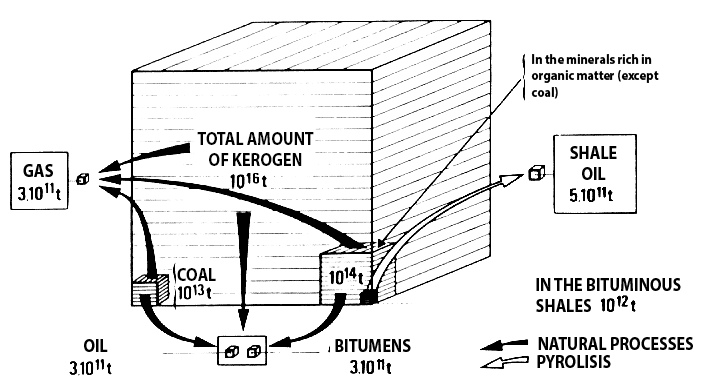
Total mass of kerogen on planetary calibration
Though information technology is generally present in very small proportions in the sediments, all kerogen on globe represents a total mass of ten.000.000 billion tonnes. 0,1% only of this kerogen (that is a thousandth of the total organic affair nowadays in sediments) will plow into coal (which still represents 10.000 billion tonnes !), and gas and oil each represent 0,003% of the total kerogen in rough figures (which withal represents a couple hundred million tonnes).
- Because of tectonics, that is a very deadening convective movement of the Earth crust, sediments somewhen slowly "sink" into the deeper ground. The ambiant temperature then increases, because of geothermal heating (incidentally geothermal energy is a kind of nuclear free energy: information technology results from the free energy freed past the natural radioactivity of the inner world !). The burrial rate beingness variable, the temperature of the sediment increases by 0,five to twenty°C per million years.
- When the ambiant temperature reaches 50 to 120 °C (the minimum temperature required depends on the age of the mother rock, it is complicated !), kerogen undergoes a decomposition of thermal origin, pyrolysis (provided there is no free oxygen effectually, otherwise the kerogen is only oxidized). In a first stage, the decomposition produced h2o and CO2 (in amounts that depend on the initial proportion of oxygen) that are expelled from the kerogen. As the temperature increases with time, the kerogen will expell liquid hydrocarbons (it is the famous oil) and "natural" gas (permit's notation that oil is every bit much "natural" !). The deeper the sediment has gone, and the higher the fraction of gas produced, because the pyrolysis has lasted for a longer fourth dimension earlier expulsion, or has decomposed partially the liquid hydrocarbons themselves. Given the slow burrial speed, a couple million years are required for the kerogen to be partly transformed, nether the consequence of heat, in oil, gas, CO2, and water.
- Each footling kerogen thread of the mother rock will thereform transform into a mixture of water+liquid hydrocarbons+gas+solid rest with a loftier proportion of carbon (considering nearly of the hydrogen has gone in the water, liquid hydrocarbons and gas). Only pretty watertight mother rock (hence with a fine grain) can concord the kerogen long enough for it to transform in a large proportion, but a issue of this watertightness is that the hydrocarbons resulting from the pyrolisis first remain very scattered.
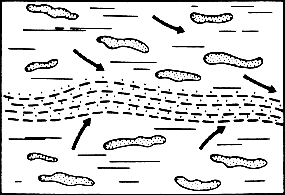
Stage 1 of kerogen transformation, at the begening of pyrolisis.
Each little thread of kerogen produced wter that is sometimes expelled under the pressure resulting from the masse of the upper layers higher up the sediment.
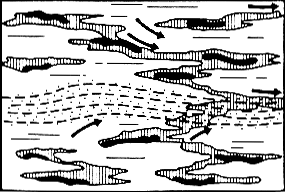
Stage 2 of kerogen transformation, during pyrolisis.
Each little thread of kerogen begins to produce hydrocarbons.
- The production of hydrocarbons is therefore a normal long term result of sedimentation as shortly as in that location is an organic fraction in the initial mixture, but without a process assuasive to "concentrate" the very diffuse gas and oil resulting from this disuse, there would non be a unmarried oilfield or gasfield in the earth.
- It'due south the apparition of gas, as the kerogen is brought to increasing temperatures (every bit a event of burrial), that will eventually cause the pyrolisis to terminate. Indeed, the pressure of the gas in the little cavities that independent the initial kerogen increases with depth (because of rise temperatures), and when the pressure becomes sufficient to overcome the "airtightness" of the mother rock, the liquid and gaseous fractions are progessively expelled from the mother stone. This expulsion is called the "chief migration" by the oil geologists. When this "primary migration" happens, the mother rock tin exist 1 one thousand thousand to 1 billion years old, the most frequent age beingness around 100 million years: oil is therefore a renewable energy… if we can wait several ten million years before burning it !
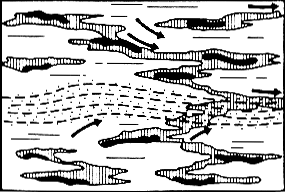
Stage 3 of kerogen transformation
Each little thread of kerogen has produced about all the hydrocarbons it could (there is well-nigh no hydrogen left in the sediment). Nether the effect of gas force per unit area, the "master migration" begins.
- After they have been expelled from the mother rock, hydrocarbons (and water) begin what is called a "secondary migration": they "ooze" forth the permeable layers that are located next to the mother rock (which is pretty watertight, as explained above), and move towards the basis under the effect of the pressure acquired by the layers located above.
- If goose egg stops this upwards movement, hydrocarbons eventually go to the ground (or just under for liquid hydrocarbons), where they are decomposed by bacteria and atomic number 82 to the formation of bitumens. Bituminous sands of the Athabasca province, in Canada, that constitute the largest known accumulation of bitumens in the world, are a proficient representative of this stage of the development of "oil". In a mode, we are facing there a compound "older than oil". These "leaks" to the surface are very frequent, and equally they may come up either from mother stone, or from reservoirs that loose some oil (run into beneath), they have been widely used equally possible signs of oilfields when the history of oil began. These leaks from reservoirs sometimes bear the name of "dismigration".
- In lodge to go a minable oil deposit, information technology is necessary that the liquid hydrocarbons "concentrate" somewhere before they get to the surface, which practically requires that they be stopped during their migration by a "trap". Such a trap is some other watertight layer that mostly forms some kind of "circumflex accent" above the porous layer when the oil circulates. It can exist a layer of salt, of argile, etc. Because of their respective density, the water expelled from the mother stone accumulates below the oil, and gas above. At this stage, the reservoir si said to exist of "conventional" oil. The rock that holds the oil is called a reservoir.
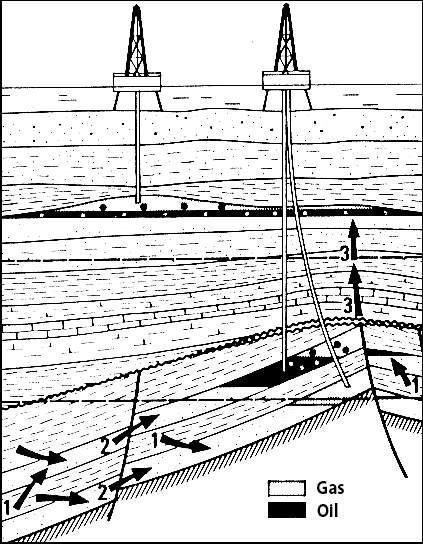
Overall picture of oil formation
1 – Master migration
2 – Secondary migration, through pores or fractures
3 – Dismigration: oil "escapes" from a reservoir where information technology previously accumulated.
- When the kerogen has produced all the hydrocarbons it could produce, it means that is has lost all its initial hydrogen. At that place remains a compound close to coal, only not mineable because information technology is still disseminated in the mother rock where it represents less than one% .
- But the history of our oil is non over ! Indeed, the oil reservoir is withal taken in the tectonics, and therefore also inexorably sinks deeper and deeper, and gets heated more and more. As a effect, the oil will undergo a second pyrolisis, which is a fiddling the equivalent of a distillation in a refinery. This pyrolisis will produce gas and a particular variety of bitumen, in increasing amounts with fourth dimension and temperature.
- If the reservoir is well tight, this new burrial will lead to the formation of a dry out gas reservoir, that is a stone with only gas (this explains why in sedimentary basins the dry gas reservoirs are generally localted below the oil reservoirs). If the reservoir is not well tight, the gas escapes and only the bitumen (or asphaltes) remain in the porosities of the reservoir rock.
- Coal is a particular variety of kerogen, that forms from remains of superior plants (copse, ferns…). It is a kerogen that has the characteristic of beingness dominant in the sediment instead of being a very a small-scale fraction of it. The kickoff stage of the sedimentation process leads to peat. During the burrial, the pyrolisis then creates lignite, and so coal, so anthracite, which is well-nigh pure carbon, with almost no hydrogen (every bit information technology is the ultimate stage of the pyrolisis anthracite is generally the deepest of all coals). Just like other kerogens, coal produces oil and gas during its burrying in the underground, though in lesser quantities regarding oil. The methyl hydride issued from the procedure and which has remained adsorbed on the coal will exist called… firedamp.

Overall picture show of coal formation.
The right centrality mentions time, in million years before present, and the left axis depth, in km (for each graph).
Each drawing represents a phase of coal formation over time, starting from the top (the upper drawing therefore represents the organization that will yield coal 320 million years ago).
The organic matter (concentrated since it comes from piles of dead plants) goes through the following stages: peat – lignite matte – lignite brilliant – difficult coal – anthracite. Each time the carbon content increases.
V1 and V2 represent a aforementioned initial organic affair that volition produce Veins (hence the Five) or seams of coal. The type of coal in the vein (A, H, etc) is mentionned in parenthesis. The successive drawings show how these veins evolve and motion in the chaff (because of tectonics) with fourth dimension.
Source : B. Durand, Energie et environnement, les risques et les enjeux d'une crise annoncée. EDP Sciences, 2007
What liquid hydrocarbons are nosotros able to excerpt ?
At the outset of oil industry, the oil that nosotros were able to extract was "conventional", that is a liquid produced by the pyrolysis of kerogen, that and so had the adept thought to concentrate in a reservoir.
Getting this oil is pretty easy : information technology requires that a tube is forced into the reservoir, and and so office of the oil spontaneously gets out under the pressure level of the associated gas, and part of the rest can be "pumped" with various techniques that continue sophisticating. With this "conventional" oil, the extraction requires, on average, a couple % of the energy that is enclosed in the oil obtained.
But oil companies are more than and more interested by "unconventional" oil that designates :
- bituminous sands and extra-heavy oil, that correspond to oil that has lost its volatile elements. It is therefore oil which is "older" than conventional oil, and that degraded close to the surface, every bit explained above, thus getting richer in heavy molecules,
- bituminous or tar shales that designate – wrongly because there is no tar in them – a mixture of rocks and kerogen that has not undergone a pyrolisis. It therefore corresponds to fuels that are "younger than oil" in the transformation process, and these resources should rather be part of the coal inventory, just like peat or lignite. These bituminous shales tin yield synthetic oil by undergoing a pyrolisis (at 500 °C in social club non to look for a million years) in a plant, but the internet balance regarding energy is poor (nearly of the time it is fifty-fifty negative, which means that the energetic content of the oil obtained is inferior to the energy spend to get it).
In all cases unconventional oil is something very thick (pasty), sometimes even solid in the atmospheric condition encountered in the reservoir, and often mixted upwardly in pocket-size proportions with rock. The deposits are much more difficult to exploit than for conventional oil:
- if it is extra-heavy oil, or bituminous sands, it is necessary to inject steam under pressure (to turn the oil fluid by heating it, and permit it to become out under the pressure of the steam), what requires to invest into the extraction a couple tens % of the energy that will be enclosed into the oil extracted,
- For bituminous shales, the fuel extraction is more like mining, and the fuel might represent only a couple % of the rocks that contains information technology. Some geologist recommend never to take these shales into business relationship when computing reserves.
It is also possible to extract gas that has been formed in a female parent stone and never migrated subsequently: "shale gas".
Source: https://jancovici.com/en/energy-transition/oil/how-do-oil-gas-and-coal-get-created/
Posted by: geehatratilis1993.blogspot.com
0 Response to "How Long Does It Take Animals To Turn Into Oil And Coal"
Post a Comment